
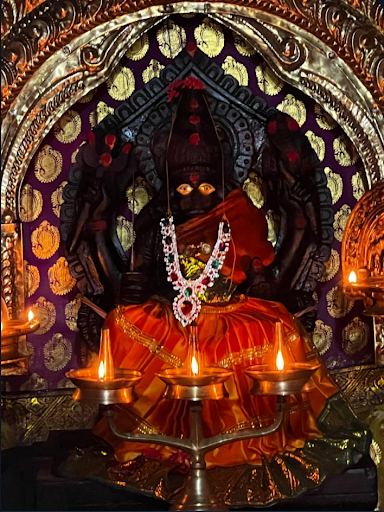
The timing of Dīpāvalī is deliberately aligned with a powerful natural juncture—the festival’s moonless night. At this turning point, the outer world is at its darkest, and the inner environment is primed for convergence—where polarities are resolved, and the system restructures to host the ascent of grace.
The self-revealing light of the Self illumines all that is seen. When conditions align, awareness shines by its own radiance. The amāvasyā (dark moon) of Dīpāvalī brings these conditions into exact configuration.
It is the zero-point of sun–moon conjunction. When no light is reflected, and the Sun moves through Tula (Libra), the system crosses a threshold.
Tula is the agency of balance—when orientation is clarified and action recalibrated. Amāvasyā draws śakti inward, toward still contact with śiva (pure presence).
Dīpāvalī’s amāvasyā is submerged in the darkest nakșatra (lunar constellation), Swati, which holds no bright star. When we align with this cosmic cycle, it is perfect placement for anchoring deep within oneself rather than wandering astray in the darkness of the season.
Dīpāvalī Sādhanā aligns us with these natural rhythms, contextualising the cosmic event, anchoring personal insight and supporting the conditions for systemic reorganisation, reintegration and renewal.
My place, my role here on earth, feels more steady, my inner GPS is more attuned, my vision clearer. With more direct support and connection with and from our grand planets.”
—Marianne, Norway
In the Tantric view, dīpa is flame—both symbol and active intelligence.
It is jyotiḥ (clarity) emerging when agni (transformational fire) and soma(distilled essence) stabilise within one integrated current.
When breath, mantra and form align, kuṇḍalinī śakti rises without force, recalibrating the system from root to crown and restoring the subtle channel of discernment and transmission.
na tatra sūryo bhāti na candratārakaṁ
nemā vidyuto bhānti kuto ’yam agniḥ
tam eva bhāntam anubhāti sarvaṁ
tasya bhāsā sarvam idaṁ vibhāti ||
There, the sun does not shine, nor the moon and stars.
Nor do lightning flashes illuminate it—what then of this fire?
It is that Self, shining alone, by which all else is lit.
By Its radiance, all of this appears illuminated.
na tatra sūryo bhāti na candratārakaṁ
nemā vidyuto bhānti kuto ’yam agniḥ
|
tam eva bhāntam anubhāti sarvaṁ
tasya bhāsā sarvam idaṁ vibhāti ||
There, the sun does not shine, nor the moon and stars.
Nor do lightning flashes illuminate it—what then of this fire?
It is that Self, shining alone, by which all else is lit.
By Its radiance, all of this appears illuminated.
“The dīpa [ghee lamp] on my altar has taken a life in me. It has become synonymous with gratitude. When my eyes rest on the flame, gratitude ignites in me in an instant.”
—Lisa, Sweden
Here’s how to best prepare for Dīpāvalī Sādhanā:
Details and recommendations for these preparations will be provided after you register.
For each live satsang, please sign onto the video call at least 5 minutes before it begins, close all other windows on your device, put your phone on ‘do not disturb’, and be ready to focus on the call. You may wish to have a notebook and pen available.
Sādhanā —ideally early each morning and evening—is integral to this SATYA module. Please be prepared to clear time on your calendar for the live satsangs and for sādhanā.
Specific mantra or other practices will be recommended by Umā, and you choose how much time you want to spend with them. This might be 15-30 minutes, or it could be an hour or more, depending on what works best for you in your circumstances.
The live satsangs will likely be 1½ to 2 hours long.
Dīpāvalī itself is a 7-night celebration—this year, from 17 to 23 October. In the days before Dīpāvalī begins, we will prepare for the festival and our sādhanā through the pre-recorded satsang and in our Telegram group. In the days after Dīpāvalī ends, we will continue exploring and integrating individual and shared experience through our Telegram communications.
In addition to the pre-recorded satsaṅga (gathering in truth) you’ll receive, we’ll also meet for two live satsaṅga via video call with Umā, on these dates:
— Tues., 14 Oct. 2025
— Mon., 20 Oct. 2025
The specific times will be decided nearer to this timeframe and will depend on which time zones participants are in.
The live satsaṅga may be 1½ to 2 hours long. In case you miss one, a recording will be made available.
These will be recorded so you can catch up if you miss one. Please contact us to discuss specific concerns about scheduling conflicts or time constraints.
During the live gatherings and in the private Telegram group, Umā is available to answer questions related to Dīpāvalī Sādhanā.
The final date to register for Dīpāvalī Sādhanā is one week before we begin—7 October 2025.
Before registering, please be sure to read our Refund Policy: https://satyatraining.com/refund-policy/
No. Dīpāvalī Sādhanā is not one of the SATYA core curriculum modules within the SATYA One-Year Foundation.
